EPIK: Precise and scalable evolutionary placement with informative k-mers
EPIK is a program dedicated to « Phylogenetic Placement » (PP) of metagenomic or metabarcoding reads on a reference tree.
It is similar in spirit and technically the successor of RAPPAS (Linard et al. 2020). EPIK achieves identical or slightly better accuracy than RAPPAS and outperforms it in speed and flexibility. In many aspects the documentation of RAPPAS remains valid.
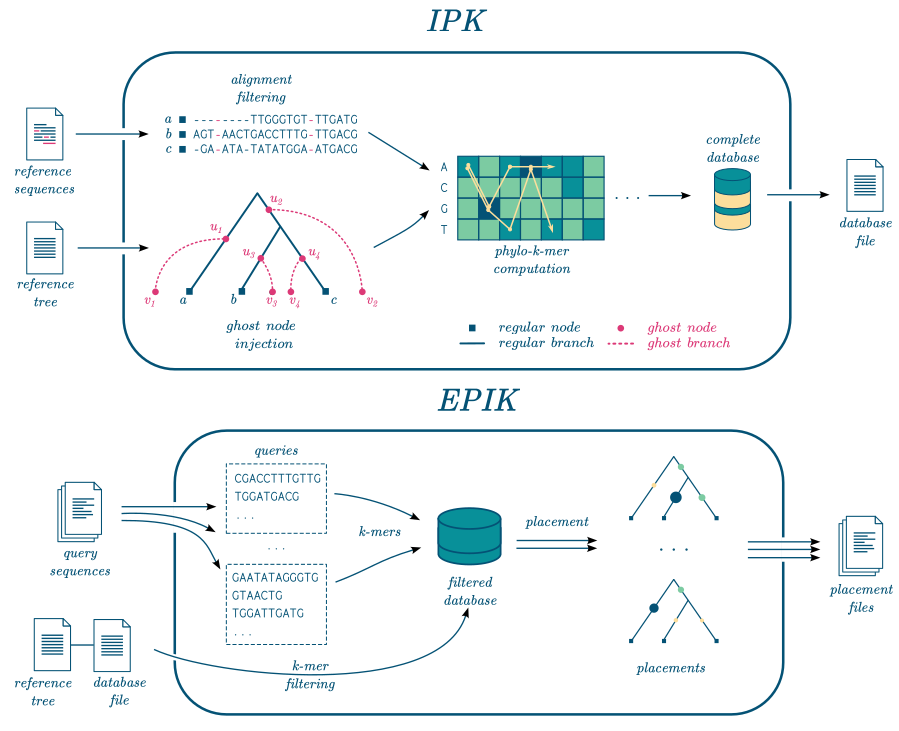
EPIK takes as input a file containing database of phylo-k-mers built with IPK and a set of reads to place on the related phylogeny. It works for nucleotidic and amino-acid query sequences.
EPIK can filter the database to load only the most informative phylo-k-mers, which reduces the memory usage.
EPIK can also run in parallel.
Keywords
Phylogenetic placement, metabarcoding, taxonomic identification, NGS, software
Other tools

DExTER
Overview DExTER (Domain Exploration To Explain gene Regulation) is a bioinformatics tool designed to automatically identify genomic regions whose nucleotide composition correlates with gene expression levels. Unlike traditional approaches focusing on short transcription factor binding sites (6-12 bp), DExTER detects Long Regulatory Elements (LREs) that can span tens to hundreds of nucleotides. This makes it…

WAVES
Warning : This application is no longer maintained and out of date. If you’re interested in, just have a look to MYST Summary WAVES is a web application dedicated to bioinformatic tool integration. It provides an efficient way to implement a service for any bioinformatic software. Such services are automatically made available in three ways:…

dipwmsearch
Protein binding sites in DNA or RNA sequences are modeled by probabilistic motifs. A Position Weight Matrix (PWM) is a simple, powerful, and widely used representation of such motifs. Because PWMs assume that sequence positions are independent of eachother (which is too restrictive for some binding or interaction sites), a generalisation of PWMs, termed di-nucleotidic…