PhyML Benchmarks – Comparison of branch support methods on simulated data sets
Comparison of alRT-based and bootstrap branch supports, using 100 simulated DNA alignments.
SH full report –
Ki2 full report –
Bootstrap full report –
Download simulated DNA data sets –
Download simulated true trees
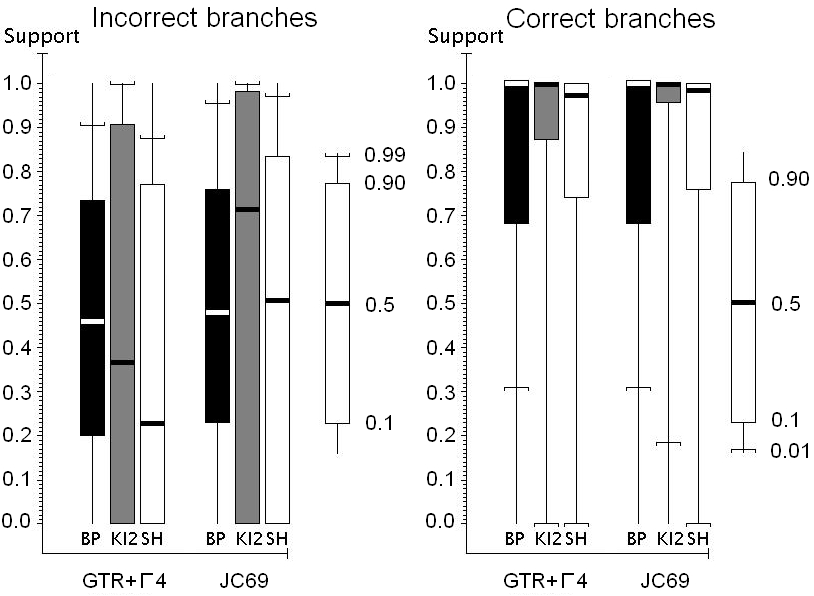
Comparison of branch supports with simulated data: these graphics show the distribution of supports (vertical axis) using boxes and whisker plots with bounds provided on the right of the corresponding panel. GTR+Γ4: both data generation and analysis (tree inference and branch testing) are performed with the same model. JC69: data are generated with GTR+Γ4, but the analysis is performed using a simple JC69 model; this mimics real data analyses in which the standard substitution models used for estimation inevitably simplify the true evolutionary processes. BP: bootstrap supports; KI2: aLRT with chi-square-based branch supports; SH: aLRT with SH-like branch supports.
Data sets
The benchmark contains 100 simulated data sets of 40 sequences and 500 sites. Data sets have been generated by Seq-Gen along random trees, using GTR model,with parameters estimated from HIV data (Posada and Crandall, 2001): nucleotide frequencies fA = 0.40, fC = 0.20, fG = 0.22, fT = 0.18, four rate categories of gamma shape parameter 0.969, and rates of nucleotide changes r(AC) = 1.72, r(AG) = 5.03, r(AT) = 0.84, r(CG) = 0.91, r(CT) = 7.70, r(GT) = 1; (M. Anisimova and O. Gascuel, 2006).
Programs
- PhyML 3.0
PhyML 3.0 is used with: SPR (and NNI) topological moves; 100 bootstrap replicates, aLRT chi-square supports and aLRT SH-like supports; GTR model; 4 discrete gamma rate categories (alpha estimated from the data).
Detailled results (full reports)
We provide here the detailled results of these experiments, plus some others, where the same GTR+G4 data are analyzed with various models, namely GTR+G4, HKY+G4, HKY, JC69+G4 and JC69.
The graphics compare the support distributions for bootstrap (BP), aLRT Ki2 (KI2) and aLRT SH-like (SH) separately for correct and incorrect branches and all experimental conditions.