DExTER
Overview
DExTER (Domain Exploration To Explain gene Regulation) is a bioinformatics tool designed to automatically identify genomic regions whose nucleotide composition correlates with gene expression levels.
Unlike traditional approaches focusing on short transcription factor binding sites (6-12 bp), DExTER detects Long Regulatory Elements (LREs) that can span tens to hundreds of nucleotides.
This makes it possible to explore a poorly characterized regulatory mechanism: gene regulation driven by the global composition of genomic regions.
The method has shown strong predictive power, explaining a large fraction of gene expression variability, reaching more than 70% prediction accuracy in Plasmodium falciparum.
Method principle
DExTER combines DNA sequences and gene expression data to identify pairs:
(k-mer motif, gene region)
whose frequency is correlated with expression level.
Main steps
- Segmentation of regions around genes
- Iterative search for k-mers correlated with expression
- Informative variable selection (LASSO / machine learning)
- Construction of a predictive gene expression model
The final model allows:
- identification of candidate regulatory regions
- explanation of expression variability
- prediction of expression of new genes
Biological applications
DExTER enables the study of regulatory mechanisms not detectable with classical motif discovery methods:
- Genomes with few transcription factors
- Post-transcriptional regulation
- Cell-cycle dependent regulation
- Epigenetic regulation linked to DNA composition
Key observations from the study:
- Highly dynamic regulation in Apicomplexa
- More stable regulation in multicellular organisms
- Distinct roles of upstream (transcriptional) vs downstream (post-transcriptional) regions
Input data
- Nucleotide sequences aligned per gene (e.g. ±2 kb around TSS or start codon)
- Gene expression matrix (RNA-seq or microarray)
Output data
- List of candidate regulatory elements (cLREs)
- Enriched motifs and associated regions
- Variable importance
- Predictive expression model
- Correlation scores between sequence and expression
You can explore an example of the results generated by DExTER here:
https://api.atgc-montpellier.fr/results/71cb194e-4dc4-4b4d-aca7-f153659cd340/
Typical use cases
- Study of non-canonical gene regulation
- Comparative genomics
- Transcriptome interpretation
- Atypical genomes (parasites, plants, protists)
Associated publication
Menichelli C. et al., 2021
Identification of long regulatory elements in the genome of Plasmodium falciparum and other eukaryotes
PLOS Computational Biology
https://doi.org/10.1371/journal.pcbi.1008909
Source code
https://gite.lirmm.fr/menichelli/DExTER
DExTER online execution
Execution API: Checking…

Other tools
LoRMA: a self correction program…
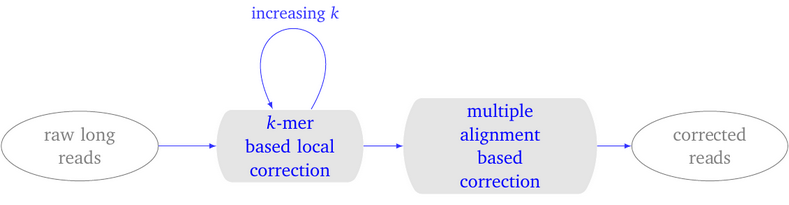
Overview LoRMA is an error correction program for long reads, which are sequences obtained using the third generation of sequencing technologies (3GS), either with Oxford Nanopore technology or with Pacific Biosciences technology. LoRMA is a so-called self-correction software, as opposed to e.g. LoRDEC that is a hybrid error correction tool. This means that LoRMA uses…

dipwmsearch
Protein binding sites in DNA or RNA sequences are modeled by probabilistic motifs. A Position Weight Matrix (PWM) is a simple, powerful, and widely used representation of such motifs. Because PWMs assume that sequence positions are independent of eachother (which is too restrictive for some binding or interaction sites), a generalisation of PWMs, termed di-nucleotidic…

LoRDEC: hybrid correction of long…
Overview In a nutshell, LoRDEC is a program for error correcting long sequencing reads using short reads. It implements a hybrid correction approach. It uses little memory and is very efficient. Most importantly it scales up to process very large data sets. It can be applied to long reads obtained with either Pacific Biosciences SMRT…