PhyML
Overview: new algorithms, methods and utilities
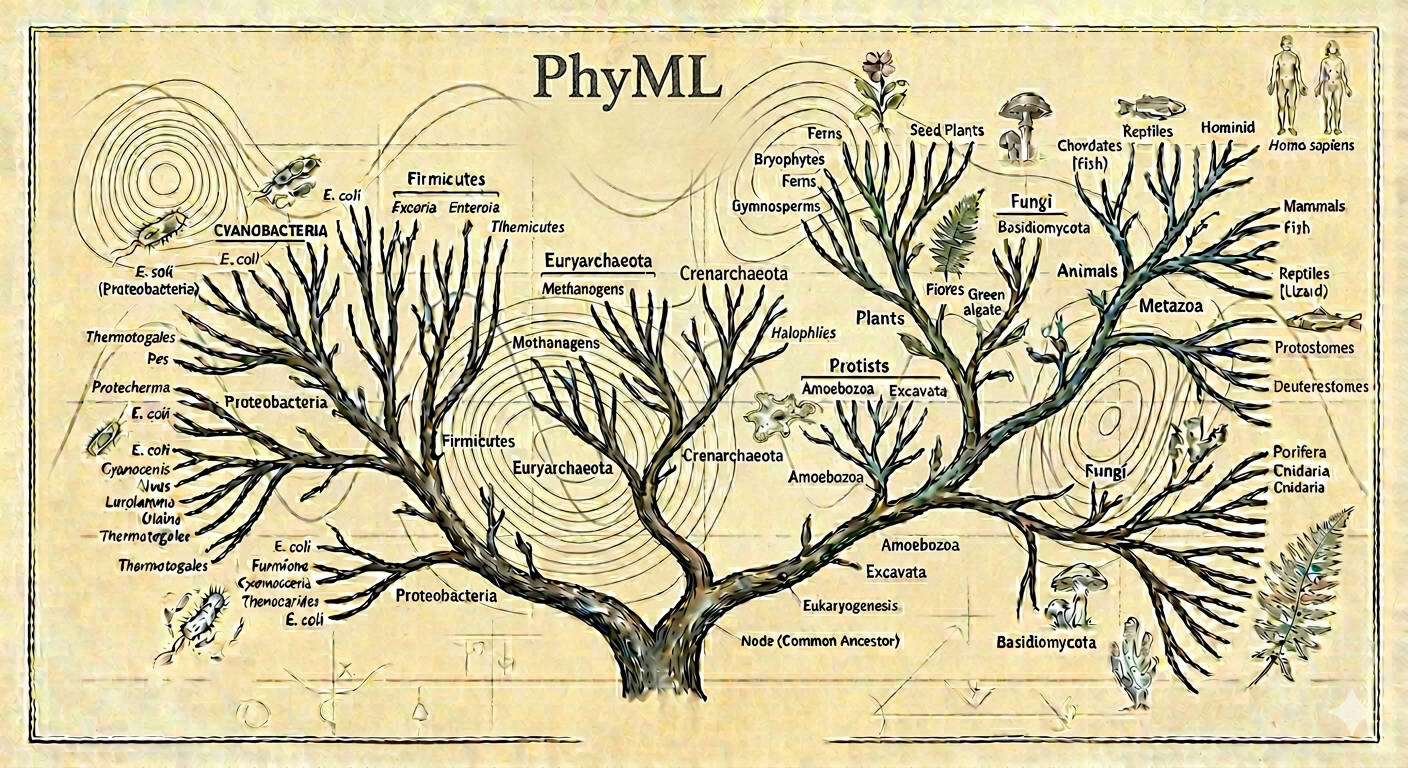
PhyML is a software package that uses modern statistical approaches to build phylogenetic trees from the analysis of alignments of nucleotide or amino acid sequences. The main tool in this package builds phylogenies under the maximum likelihood criterion. It implements a large number of substitution models coupled to efficient options to search the space of phylogenetic tree topologies.
The version that you can try inline on this page is PhyML 3.3. You can get and install it by downloading the code from https://github.com/stephaneguindon/phyml/.
Installation
Get the latest version !
You would find all PhyML releases here : https://github.com/stephaneguindon/phyml/releases
After unpacking the archive, go into the phyml/ folder and type the following command:
sh ./autogen.sh;If you are using a Mac computer or running a Unix-like operating system, you will need to install the packages autoconf automake and pkg-config. On a Mac, the following command should set you up (provided Homebrew is installed on your Mac…): brew install pkg-config autoconf automake;
Next, to install any program that is part of the PhyML package, type the following commands:
./configure --enable-phyml;
make;
To compile a Windows executable, install MinGW and run:
./configure --enable-win --enable-phyml;
make;
To install the MPI version of PhyML, type the following commands:
autoreconf -i;
./configure --enable-phyml-mpi;
make;
PhyML online execution
Execution API: Checking…
Submitting an analysis is subject to the Terms of Use. The privacy policy explains how submitted data and notification emails are processed. Audience cookies are optional and are not required to run an analysis.
Other tools

dipwmsearch
Protein binding sites in DNA or RNA sequences are modeled by probabilistic motifs. A Position Weight Matrix (PWM) is a simple, powerful, and widely used representation of such motifs. Because PWMs assume that sequence positions are independent of eachother (which is too restrictive for some binding or interaction sites), a generalisation of PWMs, termed di-nucleotidic…

AQUAPONY
AquaPony: interactive visualization of phylogeographic scenarios AquaPony is a web application designed to explore and interpret evolutionary scenarios on annotated phylogenetic trees (for example, ancestral geographic states). It was built to make uncertainty in ancestral reconstructions easier to understand and communicate. Why AquaPony? In phylogeography, several scenarios can be nearly as plausible as the best…
LoRMA: a self correction program…
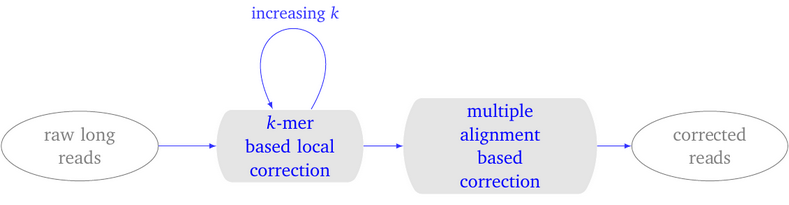
Overview LoRMA is an error correction program for long reads, which are sequences obtained using the third generation of sequencing technologies (3GS), either with Oxford Nanopore technology or with Pacific Biosciences technology. LoRMA is a so-called self-correction software, as opposed to e.g. LoRDEC that is a hybrid error correction tool. This means that LoRMA uses…