WAVES
Warning : This application is no longer maintained and out of date. If you’re interested in, just have a look to MYST
Summary
WAVES is a web application dedicated to bioinformatic tool integration. It provides an efficient way to implement a service for any bioinformatic software. Such services are automatically made available in three ways: web pages, web forms to include in remote websites, and a RESTful web services API to access remotely from applications. In order to fulfill the service’s computational needs, WAVES can perform computation on various resources and environments, such as Galaxy instances.
Availability and implementation
WAVES was developed with Django, a Python-based web framework. It was designed as a reusable web application. It is fully portable, as only a Python installation is required to run Django. It is licensed under GNU General Public License version 3.
WAVES components
WAVES-core
This is the main WAVES component.
- GitHub repository: https://github.com/lirmm/waves-core
- Documentation: http://waves-core.readthedocs.io
- Installation guide: http://waves-core.readthedocs.io/en/latest/installation.html
- Administration guide: http://waves-core.readthedocs.io/en/latest/user_doc/user_guide.html
- Tutorial to create a ‘Hello world’ service: http://waves-core.readthedocs.io/en/latest/user_doc/howto/howto.html
- Developer guide: http://waves-core.readthedocs.io/en/latest/dev_doc/dev_doc.html
- Python code examples to interact with WAVES API: http://waves-core.readthedocs.io/en/latest/dev_doc/sample_code.html
WAVES-Galaxy
This is a WAVES adapter dedicated to Galaxy. Using the BioBlend python library, this adapter enables Galaxy services import into WAVES-core. WAVES-Galaxy automatically recognizes the tools available in a Galaxy instance.
- GitHub repository: https://github.com/lirmm/waves-galaxy
- Documentation: http://waves-galaxy-adaptors.readthedocs.io
WAVES-demo
This is a custom WAVES instance for demo purpose. It was created to show what could be done with Django functionalities to custom a WAVES installation.
- GitHub repository: https://github.com/lirmm/waves-demo
- Documentation: http://waves-demo.readthedocs.io
- Demo:
http://waves.demo.atgc-montpellier.fr(no more available)
The changes that have been made are:
- Use a different skin for the back-office interface.
- Custom front-end interface.
- Override the Service class.
- Override the Authentication class.
Please note that anyone can login the back-office administration interface and create new services. Thus, for security reasons, we intentionally deactivated the jobs running procedure.
WAVES Singularity image
This is a Singularity container with a functional WAVES installation including two pre-configured services (‘Hello world’ and ‘PhyML’). For testing purpose.
- Singularity image: wavestest.simg
- Documentation: http://waves-core.readthedocs.io/en/latest/extensions.html#just-have-a-try
Other tools
PhyML
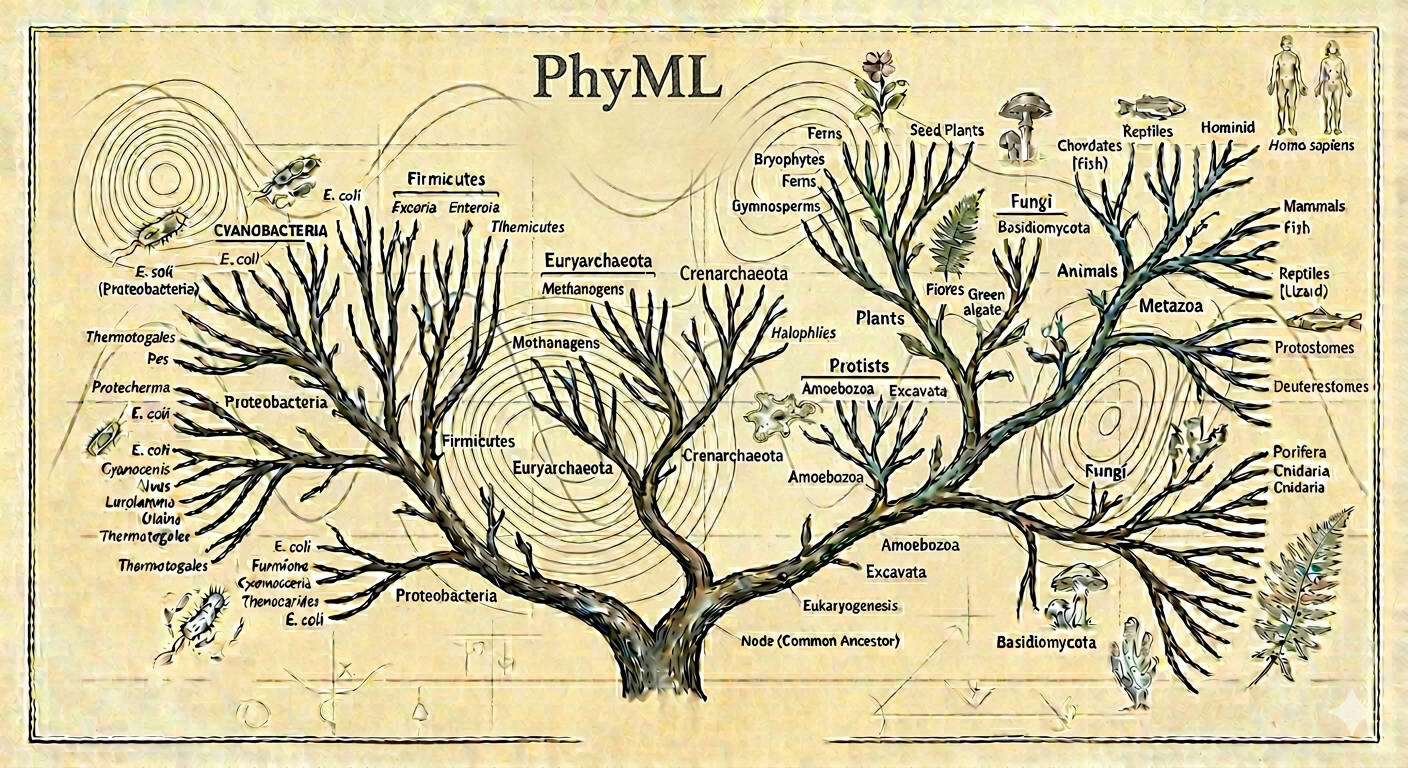
Overview: new algorithms, methods and utilities PhyML is a software package that uses modern statistical approaches to build phylogenetic trees from the analysis of alignments of nucleotide or amino acid sequences. The main tool in this package builds phylogenies under the maximum likelihood criterion. It implements a large number of substitution models coupled to efficient…

ERaBLE: Evolutionary Rates and Branch…
ERaBLE estimates branch lengths and relative gene evolutionary rates from a reference phylogeny and a collection of gene distance matrices. It provides a way to add evolutionary distance information to a topology obtained from a previous phylogenetic analysis. What does ERaBLE do? ERaBLE takes one distance matrix per gene and a tree describing the relationships…

SMS: Smart Model Selection in…
SMS (Smart Model Selection) automatically selects the best-fitting evolutionary model for an alignment of DNA or protein sequences. It compares substitution models using the AIC or BIC statistical criteria to support phylogenetic tree reconstruction with PhyML.