ERaBLE: Evolutionary Rates and Branch Lengths Estimation
ERaBLE estimates branch lengths and relative gene evolutionary rates from a reference phylogeny and a collection of gene distance matrices. It provides a way to add evolutionary distance information to a topology obtained from a previous phylogenetic analysis.
What does ERaBLE do?
ERaBLE takes one distance matrix per gene and a tree describing the relationships among the taxa. It fits branch lengths to that fixed topology while allowing different genes to evolve at different relative rates.
Distances may be estimated from gene sequence alignments or calculated from gene trees as the sum of branch lengths between each pair of taxa. Different genes may cover different subsets of the reference taxa.
What do I need?
- A reference tree in Newick format.
- A text file containing one distance matrix per gene.
- The alignment length for each gene, included in its matrix header.
The distances and the reference topology must be prepared before running ERaBLE. The online form accepts these files directly; sequence alignments and collections of gene trees require prior conversion to distance matrices.
See the input and parameter guide and the worked examples for the required formats.
Results
ERaBLE produces a Newick tree with estimated branch lengths and one relative evolutionary rate per gene. The topology is preserved. Branch lengths describe evolutionary change in substitutions per site, rather than elapsed time.
The online service displays the tree and provides downloadable gene rates, an analysis summary and the execution log.
Run ERaBLE online
Run an analysis with the embedded form below when available. Upload your reference topology and gene distance matrices, give the analysis a name, and enter and confirm your email address.
Follow any email verification instructions and keep the job link. The result page displays the estimated tree, gene rates and scientific diagnostics, with complete files available to download. You can also use the software downloads below to run ERaBLE locally.
Downloads
- ERaBLE 1.0 for Unix and Linux
- ERaBLE 1.0 for Windows
- Official repository with software archives and research datasets
The software is distributed under the GNU General Public License, version 3. The Unix/Linux archive includes the source code and example input files.
Citation
Please cite ERaBLE when using it in your research:
Binet M, Gascuel O, Scornavacca C, Douzery EJP, Pardi F. Fast and accurate branch lengths estimation for phylogenomic trees. BMC Bioinformatics. 2016;17:23. doi:10.1186/s12859-015-0821-8.
Contact
For questions about access to the ATGC service, contact atgc-contact@lirmm.fr. Please include the job identifier when reporting a problem with an online analysis.
ERaBLE: Evolutionary Rates and Branch Lengths Estimation online execution
Execution API: Checking…
Submitting an analysis is subject to the Terms of Use. The privacy policy explains how submitted data and notification emails are processed. Audience cookies are optional and are not required to run an analysis.

Other tools
PhyML
Overview: new algorithms, methods and utilities PhyML is a software package that uses modern statistical approaches to build phylogenetic trees from the analysis of alignments of nucleotide or amino acid sequences. The main tool in this package builds phylogenies under the maximum likelihood criterion. It implements a large number of substitution models coupled to efficient…
EPIK: Precise and scalable evolutionary…
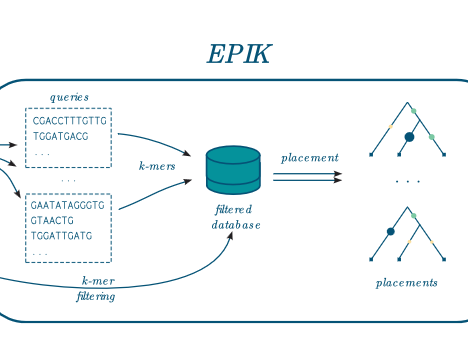
EPIK is a program dedicated to « Phylogenetic Placement » (PP) of metagenomic or metabarcoding reads on a reference tree. It is similar in spirit and technically the successor of RAPPAS (Linard et al. 2020). EPIK achieves identical or slightly better accuracy than RAPPAS and outperforms it in speed and flexibility. In many aspects the documentation of RAPPAS…

MYST : Manage Your Scientific…
What is MYST? MYST is the orchestration platform behind ATGC online bioinformatics services. It provides a unified web interface and a public REST API to submit analyses, monitor jobs, and retrieve results across a growing catalog of phylogenetic and sequence-analysis tools. MYST is a modernized redesign of WAVES, an older tool previously developped by ATGC…