PhyML
Overview: new algorithms, methods and utilities
PhyML is a software package that uses modern statistical approaches to build phylogenetic trees from the analysis of alignments of nucleotide or amino acid sequences. The main tool in this package builds phylogenies under the maximum likelihood criterion. It implements a large number of substitution models coupled to efficient options to search the space of phylogenetic tree topologies.
The version that you can try inline on this page is PhyML 3.3. You can get and install it by downloading the code from https://github.com/stephaneguindon/phyml/.
Installation
Get the latest version !
You would find all PhyML releases here : https://github.com/stephaneguindon/phyml/releases
After unpacking the archive, go into the phyml/ folder and type the following command:
sh ./autogen.sh;If you are using a Mac computer or running a Unix-like operating system, you will need to install the packages autoconf automake and pkg-config. On a Mac, the following command should set you up (provided Homebrew is installed on your Mac…): brew install pkg-config autoconf automake;
Next, to install any program that is part of the PhyML package, type the following commands:
./configure --enable-phyml;
make;
To compile a Windows executable, install MinGW and run:
./configure --enable-win --enable-phyml;
make;
To install the MPI version of PhyML, type the following commands:
autoreconf -i;
./configure --enable-phyml-mpi;
make;
PhyML online execution
Execution API: Checking…
Submitting an analysis is subject to the Terms of Use. The privacy policy explains how submitted data and notification emails are processed. Audience cookies are optional and are not required to run an analysis.
Other tools
EPIK: Precise and scalable evolutionary…
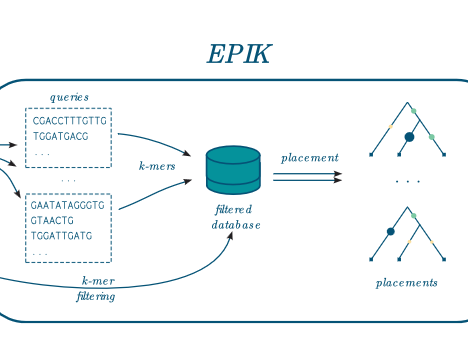
EPIK is a program dedicated to « Phylogenetic Placement » (PP) of metagenomic or metabarcoding reads on a reference tree. It is similar in spirit and technically the successor of RAPPAS (Linard et al. 2020). EPIK achieves identical or slightly better accuracy than RAPPAS and outperforms it in speed and flexibility. In many aspects the documentation of RAPPAS…

ERaBLE: Evolutionary Rates and Branch…
ERaBLE estimates branch lengths and relative gene evolutionary rates from a reference phylogeny and a collection of gene distance matrices. It provides a way to add evolutionary distance information to a topology obtained from a previous phylogenetic analysis. What does ERaBLE do? ERaBLE takes one distance matrix per gene and a tree describing the relationships…
RSCU_RS: Measuring the bias in…
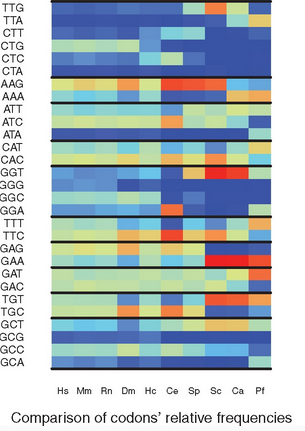
Overview Overview: In the protein coding sequences of a species, the 61 possible codons of the genetic code are not equally distributed. This observation is referred to as the Codon Usage Bias (CUB) of a species. Several measures have been proposed to quantify the CUB using the frequencies of codons in all RNA coding sequences…