CompPhy
CompPhy: a web-based collaborative platform for comparing phylogenies
CompPhy is a web platform dedicated to the collaborative handling of phylogenetic trees. Users can freely manage collections of trees and communicate on a common project. By collaborative, we mean that several users connected to the same project can manipulation at the same time trees from shared collections. The platform is flexible enough to allow each user to focus on some trees or to follow trees manipulated by another user. The platform offers various functionalities covering tree edition, tree comparison, supertree inference, data management.
Why CompPhy?
Online collaborative and real-time tools are needed in various domains for projects involving remote partners. In the last twenty years, web technologies have enabled the development of such tools to jointly edit office documents. However, only few such tools exist in scientific domains. Particularly in phylogentics, prior to the introduction of the CompPhy website, no collaborative tool was available to handle phylogenies.
Key features
- Collaborative editing collection of trees: shared tree visualization, (a)synchronous manipulation of trees, data exchange/storage, …
- Tree edition and taxa annotation: coloration and fonts, shape of the tree, subtree collapsing, …
- Tree comparison: side-by-side display, swapping leaves to ease comparison, MAST, Robinson & Foulds distance
- Supertree inference: MRP, Physic_IST, Astral
- Data management: timeline, associated documents, message forum, backups, …
Access the tool
Use CompPhy here: http://old.atgc-montpellier.fr/compphy/
User guide
Consult the user guide to discover all functionalities.
Scientific reference
« CompPhy: a web-based Collaborative Platform for Comparing Phylogenies », N. Fiorini, V. Lefort, F. Chevenet, V. Berry, A.-M. Arigon Chifolleau, BMC Evol Biol. 2014 Dec 14; 14(1):253.

Other tools

ERaBLE: Evolutionary Rates and Branch…
ERaBLE is a phylogenomic distance-based method to simultaneously estimate the branch lengths of a given reference topology, and the relative evolutionary rates of the genes employed in the analysis, using a collection of distance matrices (one distance matrix per gene). These distance matrices can either be directly estimated from pairwise alignments of the gene sequences,…
EPIK: Precise and scalable evolutionary…
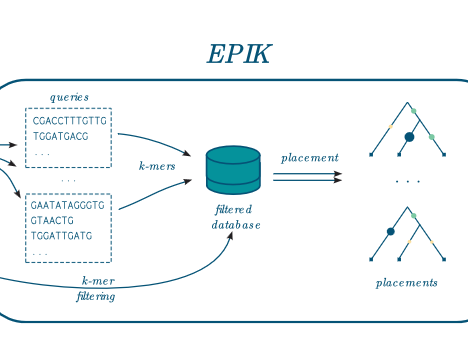
EPIK is a program dedicated to « Phylogenetic Placement » (PP) of metagenomic or metabarcoding reads on a reference tree. It is similar in spirit and technically the successor of RAPPAS (Linard et al. 2020). EPIK achieves identical or slightly better accuracy than RAPPAS and outperforms it in speed and flexibility. In many aspects the documentation of RAPPAS…

SMS: Smart Model Selection in…
SMS (Smart Model Selection) automatically selects the best-fitting evolutionary model for an alignment of DNA or protein sequences. It compares substitution models using the AIC or BIC statistical criteria to support phylogenetic tree reconstruction with PhyML.